
Spring steel is selected for components that must deflect under load, recover after unloading and resist permanent set or fatigue damage through repeated cycles. The alloy name is only one part of that requirement. Final spring performance also depends on section size, heat treatment, surface condition, decarburization control, residual stress, forming history and the actual stress in service.
This guide helps overseas engineers and procurement teams interpret spring-steel requirements before sourcing raw material or drawing-based machined parts in China. It is an engineering overview, not a substitute for the controlled standard, material certificate, heat-treatment specification or component validation plan.
GB/T 1222 and GB/T 4357 Are Different Standards
The first step is to identify the product form. GB/T 1222-2025, Spring steels, is the current Chinese national standard for spring-steel products. It replaced GB/T 1222-2016 and became effective on May 1, 2026. It is the relevant starting point when a drawing or purchase specification calls for spring-steel material such as bar, flat material or another steel product covered by the standard.
GB/T 4357-2022, Cold-drawn unalloyed steel wire for springs, applies to finished cold-drawn spring wire. Wire diameter, tensile class, surface condition and wire-specific designation are therefore controlled in a different product context. A finished wire designation should not be treated as though it were a GB/T 1222 steel grade.
| Reference | Main product context | What buyers should define |
|---|---|---|
| GB/T 1222-2025 | Spring-steel material and grade requirements | Grade, product form, dimensions, delivery condition, heat treatment and required properties |
| GB/T 4357-2022 | Finished cold-drawn unalloyed spring wire | Wire standard and edition, class or designation, diameter, surface condition and application duty |
Terms such as piano wire, SH and DH belong to the spring-wire product and duty-classification context, not to the list of GB/T 1222 spring-steel grades. SH and DH are commonly associated with static-duty and dynamic-duty wire classifications. The exact meaning, strength range and test requirements must be confirmed against the wire standard and edition specified on the drawing or purchase order.
Official standard records: GB/T 1222-2025 and GB/T 4357-2022.
What Mechanical Properties Matter for Spring Steel?
A spring or elastic component must store and release elastic energy without exceeding its functional limit. For that reason, spring-steel specifications are read as a balance of strength, resistance to permanent deformation, ductility, toughness and fatigue performance. A high tensile-strength number alone does not establish that a material is suitable for the application.
Tensile Strength, Rm
Tensile strength is the maximum engineering stress reached during a tensile test before fracture. It indicates the material's strength base, but it does not define the allowable working stress of a spring by itself.
Yield Strength, ReL or Rp0.2
Yield strength indicates when significant permanent deformation begins. This is especially important for elastic components because a spring that exceeds its elastic range may take a permanent set and lose dimensional or force consistency.
Elongation, A, and Reduction of Area, Z
Elongation and reduction of area indicate ductility and deformation capacity. As carbon content and strength increase, ductility and toughness can decrease. A spring steel can therefore be strong yet still be unsuitable if brittle fracture, notch sensitivity or fatigue cracking is the dominant risk.
Heat Treatment Is Part of the Property Definition
Carbon and alloying elements provide the hardenability and strength potential. Quenching and tempering develop the final combination of hardness, yield strength, toughness and dimensional stability. Buyers should never specify only a grade when the final component also requires a controlled hardness range or mechanical-property condition.
How the Main Alloying Elements Work
| Element | Primary contribution | Engineering caution |
|---|---|---|
| Carbon, C | Provides the basic potential for hardness and strength after heat treatment. | Higher carbon can reduce ductility, toughness and machinability. More carbon does not automatically mean a better spring. |
| Manganese, Mn | Improves strength and hardenability and supports a more effective heat-treatment response. | Delivery condition and section size still affect machining and final properties. |
| Silicon, Si | Supports elastic-limit performance and tempering stability; important in silicon-manganese spring steels. | Surface condition and decarburization control remain important for fatigue-sensitive parts. |
| Chromium, Cr | Improves hardenability, strength and wear resistance, especially for larger sections or higher stress. | Harder delivery conditions increase tool wear and machining risk. |
| Vanadium, V | Refines grain and can improve strength, toughness and fatigue performance. | Heat-treatment control is required to obtain the intended benefit. |
| Molybdenum, Mo | Supports tempering stability and properties through larger sections. | Material equivalence must be checked carefully across national standards. |
| Tungsten, W | Supports tempering stability and elevated-temperature performance in specialized grades. | Not normally selected for routine spring clips or general-purpose springs. |
| Phosphorus and sulfur, P/S | Residual elements that are controlled rather than deliberately used for spring performance. | Excess levels can reduce toughness and fatigue resistance; critical applications may require tighter control. |
Spring-Steel Grade Families Buyers May Encounter
Chinese drawings and legacy purchase specifications may show several families of spring-steel grades. The grouping below explains the selection logic. Confirm that the exact designation remains valid in the required edition of GB/T 1222 and do not substitute a grade solely because the names appear similar.
Carbon Spring Steels: 65, 70, 80 and 85
These grades rely mainly on carbon to provide the strength and hardness potential developed through heat treatment. As carbon increases, achievable strength generally rises while ductility, toughness and machining ease tend to fall. They are used where section size, loading and hardenability requirements do not require a more highly alloyed steel.
Manganese Spring Steels: 65Mn and 70Mn
Manganese improves hardenability compared with plain carbon spring steel. 65Mn is widely encountered in spring clips, retaining rings, elastic plates, saw blades and similar parts. The required final hardness and the risk of distortion or cracking should be defined before machining and heat treatment are planned.
Silicon and Silicon-Manganese Steels: 38Si2 and 60Si2Mn
Silicon supports elastic-limit and tempering performance, while manganese contributes strength and hardenability. 60Si2Mn is commonly associated with load-bearing coil springs, leaf springs and other parts requiring greater spring capacity than ordinary 65Mn applications.
Silicon-Chromium and Chromium-Manganese Steels
Grades such as 55SiCr, 60Si2Cr, 55CrMn and 60CrMn use chromium, silicon and manganese to improve hardenability and strength through larger sections. They may be considered for higher-stress or larger spring parts where a plain carbon or silicon-manganese steel does not provide a sufficient process window.
Boron-Containing Spring Steels
Grades encountered in this family include 28SiMnB, 55SiMnVB, 60CrMnB and 40SiMnVBE. Small boron additions can materially improve hardenability. Because the designation may also indicate other alloying or treatment considerations, buyers should confirm the controlled standard edition and certificate requirements instead of ordering by a shortened commercial name.
Chromium-Vanadium and Silicon-Chromium-Vanadium Steels
Examples include 50CrV, 51CrMnV, 55SiCrV and 60Si2CrV. Chromium supports hardenability and strength; vanadium supports grain refinement, toughness and fatigue performance. These families are often considered for important, high-stress or fatigue-sensitive spring components.
Molybdenum and Multi-Alloy Spring Steels
60CrMnMo, 52CrMnMoV, 52SiCrMnNi, 56Si2MnCr and 60Si2MnCrV combine several alloying mechanisms. Molybdenum supports tempering stability, nickel can support toughness, and vanadium can support grain control. These materials are selected for demanding applications only after load, section size, heat treatment and fatigue risk are understood.
Tungsten-Chromium-Vanadium Steel: 30W4Cr2V
This is a specialized alloy family in which tungsten supports tempering stability and elevated-temperature behavior. It should not be treated as a routine replacement for 65Mn or 60Si2Mn.
Practical Selection Logic for Common Grades
| Typical grade family | Common reason for selection | Typical component context |
|---|---|---|
| 65Mn | Cost-effective manganese spring steel with broad availability and useful hardenability for ordinary elastic parts. | Spring clips, retaining rings, elastic plates, clamp parts and similar components. |
| 60Si2Mn | Higher elastic-limit and load-bearing potential for demanding spring action. | Load-bearing coil springs, leaf springs and larger elastic components. |
| 50CrV / 50CrVA family | Improved strength, toughness and fatigue potential for important springs. | High-stress, fatigue-sensitive or safety-relevant spring components after engineering validation. |
The final selection should be based on working stress, load cycle, operating temperature, corrosion exposure, section size, heat-treatment capability, surface condition and required fatigue life. Material selection should be confirmed by the product designer or responsible materials engineer.
CNC Machining and Heat-Treatment Risks
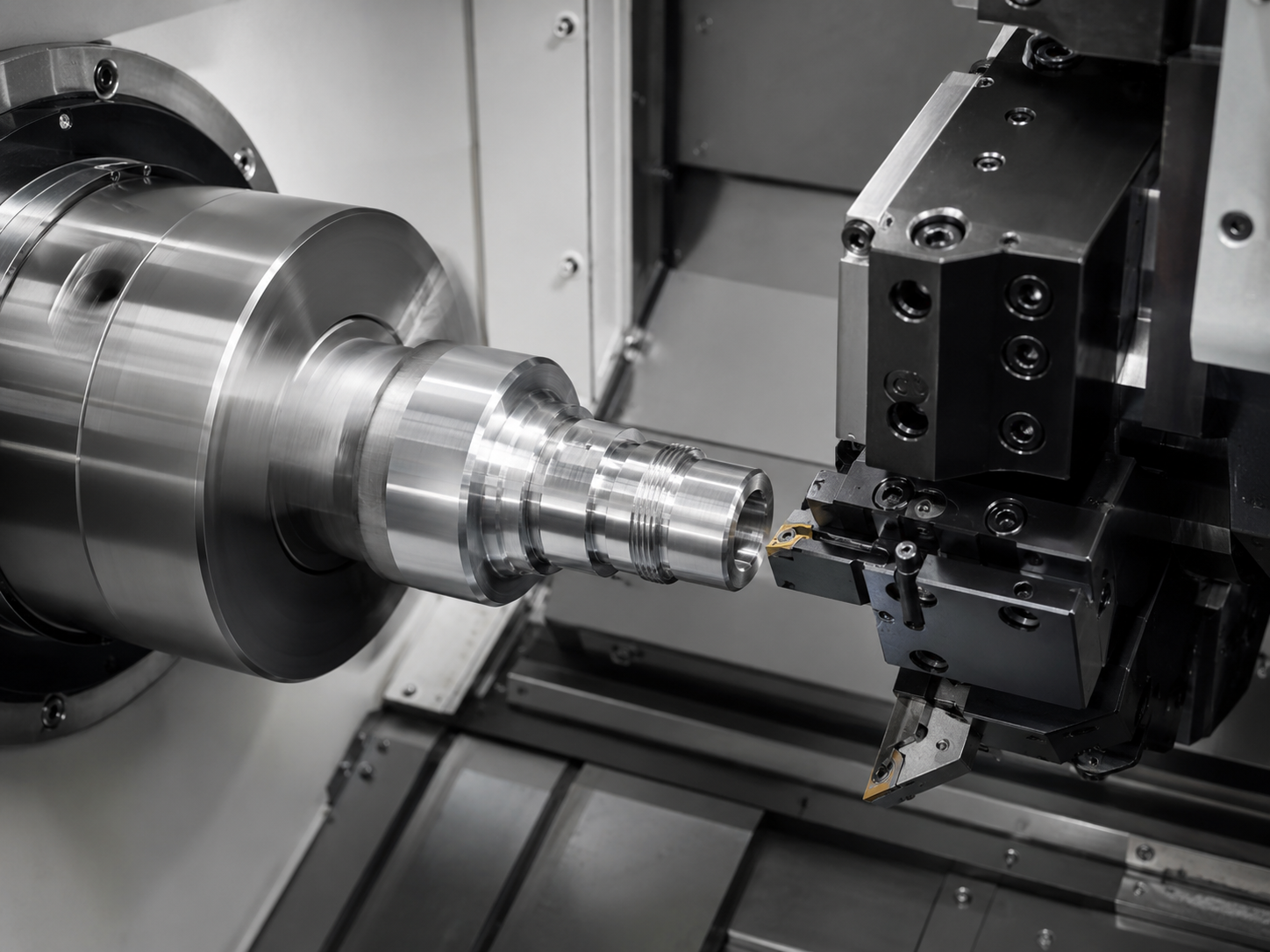
Many spring steels are easier to machine in an annealed or softened delivery condition. Where the design allows, rough and finish machining are planned around the final hardening sequence so that tool wear, distortion and tolerance loss are controlled. Machining a fully hardened spring steel can require different tooling, reduced cutting parameters or grinding, and may not be suitable for every geometry.
- Delivery condition: State whether the raw material is annealed, normalized, quenched and tempered, or supplied to a hardness range.
- Heat-treatment sequence: Define whether machining occurs before or after final hardening and which supplier owns the heat-treatment process.
- Distortion: Thin sections, asymmetric features, long shafts and interrupted geometry may move during quenching and tempering.
- Decarburization: Carbon loss at the surface can reduce hardness and fatigue performance in highly stressed areas.
- Surface integrity: Tool marks, sharp transitions, grinding burns, burrs and handling damage can become fatigue initiation sites.
- Threads and holes: Small threads, cross holes and deep features may be difficult to finish after hardening and should be sequenced deliberately.
- Inspection timing: Critical dimensions, hardness, runout and surface condition may need checks both before and after heat treatment.
RFQ Checklist for Machined Spring-Steel Parts
A useful RFQ should define both the geometry and the material condition. For a drawing-based spring-steel component, provide:
- 2D drawing and, where available, a 3D model.
- Exact grade, standard number and required standard year.
- Permitted equivalent grades, or a clear statement that substitution is not allowed.
- Raw-material product form, dimensions and delivery condition.
- Final heat treatment, hardness range and mechanical-property requirements.
- Quantity, expected repeat demand and target delivery date.
- Critical dimensions, datum structure, runout, fit and surface-finish requirements.
- Features that experience cyclic stress or must remain free of burrs and tool marks.
- Surface protection, coating, shot peening or other post-treatment requirements.
- Material certificate, hardness report, inspection report or testing requirements.
Key Takeaway
Spring steel is not simply high-strength steel that "springs back." Good performance requires a controlled relationship between tensile strength, yield strength, ductility, toughness, fatigue resistance, heat treatment and surface condition. Carbon provides the strength base; manganese and chromium improve hardenability; silicon supports elastic-limit and tempering behavior; vanadium supports grain and fatigue performance; and molybdenum or tungsten can support tempering stability in more demanding grades.
For CNC machined spring-steel parts, the drawing review should connect material grade with delivery condition, final hardness, machining sequence, distortion risk and inspection method. Review material-specific CNC machining resources, CNC turning capabilities, turn-mill machining capabilities and quality inspection planning before preparing the RFQ.
FAQ
Is 65Mn the same as piano wire?
No. 65Mn is a spring-steel grade designation, while piano wire describes a finished high-strength spring-wire product. The applicable product standard, wire class, diameter and condition must be specified separately.
Should spring steel be machined before hardening?
Often yes, because an annealed or softened condition reduces tool wear and makes complex features easier to produce. The process plan must still allow for heat-treatment distortion, finishing stock and final inspection.
Does a higher carbon content always make a better spring?
No. Higher carbon can increase hardness and strength potential, but it can also reduce ductility, toughness and machinability. The best grade balances load, fatigue, section size, heat treatment and service environment.
Can DXSCNC quote a machined spring-steel component from a grade name alone?
A drawing review is needed. Please provide geometry, standard and edition, delivery condition, final heat treatment or hardness, quantity, critical tolerances and inspection requirements.
Need a machining review for a spring-steel component?
Send the drawing, material standard and grade, delivery condition, heat-treatment requirement, quantity and critical inspection notes.
Send Drawings for Review